
Evaluating the feasibility and perceptions of a senior-friendly tablet among older adults in Singapore: A mixed-methods study
Chew Sim Chee, Jayven Jun Yong Cheo, Kimberly Jia Li Chua, Rico Zhen Jun Chia and Tricia Jiayi Lim - Temasek Polytechnic, Singapore
Gerontechnology (2022) 21:1 · doi.org/10.4017/gt.2022.21.1.597.10
Digital technologies are becoming increasingly pervasive and integrated into our everyday life. This presents innovative opportunities to enhance older adults' independent living and mental well-being. The current study has shown that most participants found the experience of using the SilverPad tablet to be satisfying and positive with demonstrable effects on their level of comfort and well-being.
What participants said
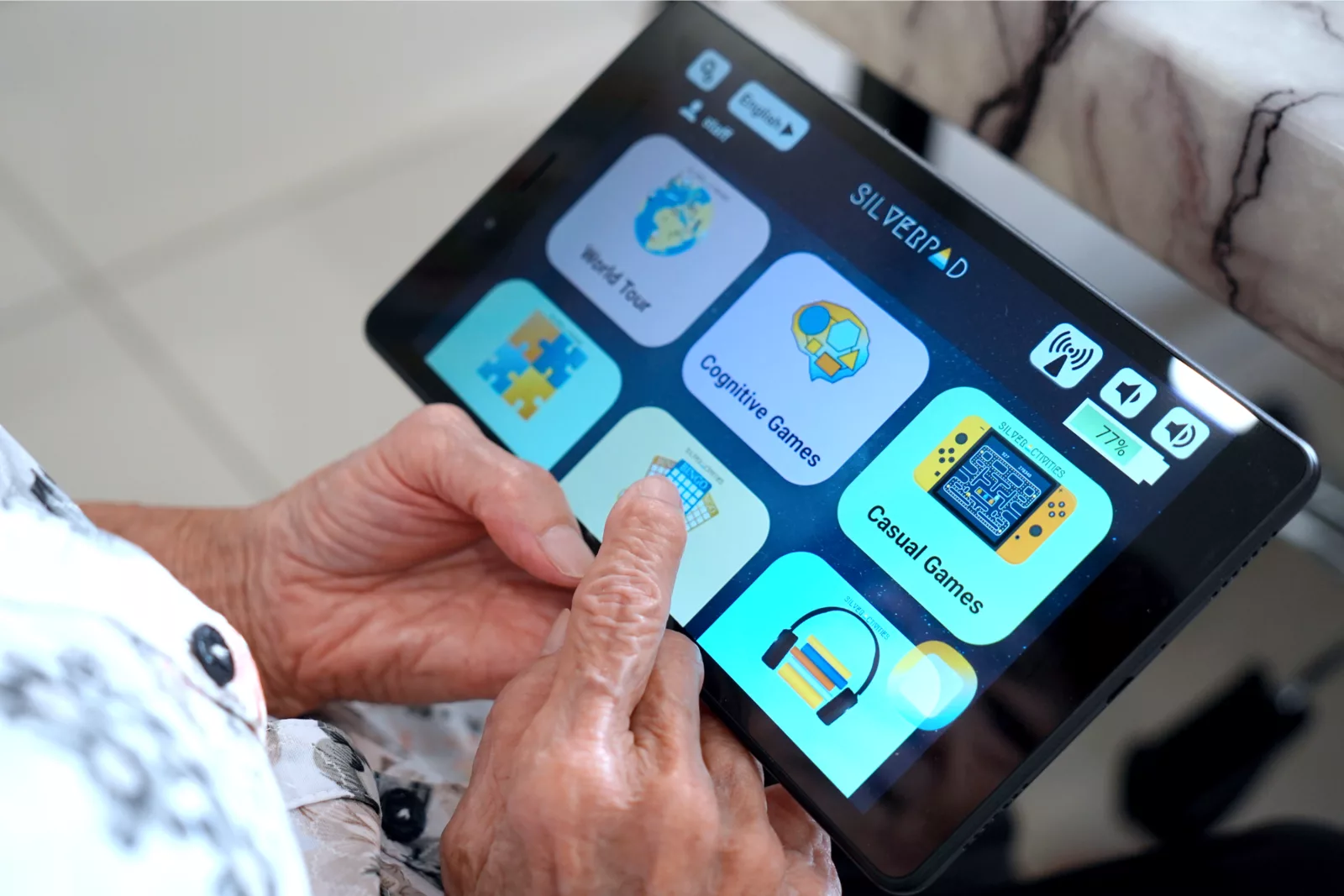
I think quite minimum effort ah [sic]… As long as you know the basic and then you just explain some of the things should be fine.
The user interface is also very simple. It's not complicated…Unlike phones that is more complicated.
…it works your mind, and then you don't feel like you have dementia or things like that because your mind will start working and you're concentrating on what is there on the tablet so you will think that it's quite interesting and you won't just daze off ah, shall I say.
If there are no teachers, then games like bingo are a lot easier to understand. The other games are a lot harder…My memory just not good so I required a lot of effort.
- Background
- Digital technologies are becoming increasingly pervasive and integrated into our everyday life. This presents innovative opportunities to enhance older adults' independent living and mental well-being. However, many older adults still lag behind in technological use. To enhance older adults' mental well-being, a senior-friendly tablet known as SilverPad has been developed that is localised and multilingual to suit Singaporean older adults and designed to be inclusive for those who are less tech-savvy. SilverPad contains a suite of cognitive games and digital contents specially designed to be engaging and mentally stimulating for the older adults. Hence, this study was motivated to explore older adults' attitudes and acceptance towards the use of digital technologies specifically SilverPad.
- Objective
- To explore the feasibility, acceptability, and perceptions of a senior-friendly tablet from older adult users in Singapore who are not tech-savvy.
- Method
- A single-group, mixed-methods, pre-post-study design was employed to assess the feasibility, acceptability, and perceptions towards SilverPad from target older adult users in Singapore. Fourteen healthy older adults, above 60 years of age, completed the study.
- Results
- Following a 2-week exposure to SilverPad, there was a significant improvement in participants' comfort level with tablet use and mental well-being. Their interest level increased slightly but was marginally significant. However, there was no significant difference in participants' sense of efficacy. Participants' qualitative feedback provided further insights notably on the themes of perceived ease of use, satisfaction, perceived benefits, positive impacts experienced, and motivation to use the tablet, with some individual differences recognized.
Outcome measures before and after 2-week tablet use
| Measure | Before | After | p (one-tailed) | Effect size (Cohen's d) |
|---|---|---|---|---|
| Comfort with tablet use | 16.29 ± 3.95 | 19.43 ± 4.40 | 0.01** | 0.71 |
| Efficacy | 19.14 ± 3.23 | 19.79 ± 3.68 | 0.31 | 0.13 |
| Interest | 20.21 ± 2.64 | 21.29 ± 3.22 | 0.05 | 0.47 |
| WHO-5 Well-being Index | 15.43 ± 7.29 | 18.71 ± 5.25 | 0.04* | 0.52 |
Comfort and well-being both improved significantly, each with a medium effect size. Interest rose slightly and efficacy did not change.
The current study has shown that most participants found the experience of using the SilverPad tablet to be satisfying and positive with demonstrable effects on their level of comfort and well-being. The study has also uncovered further insights on the usability and acceptability of using SilverPad that supports its feasibility to benefit older adults.
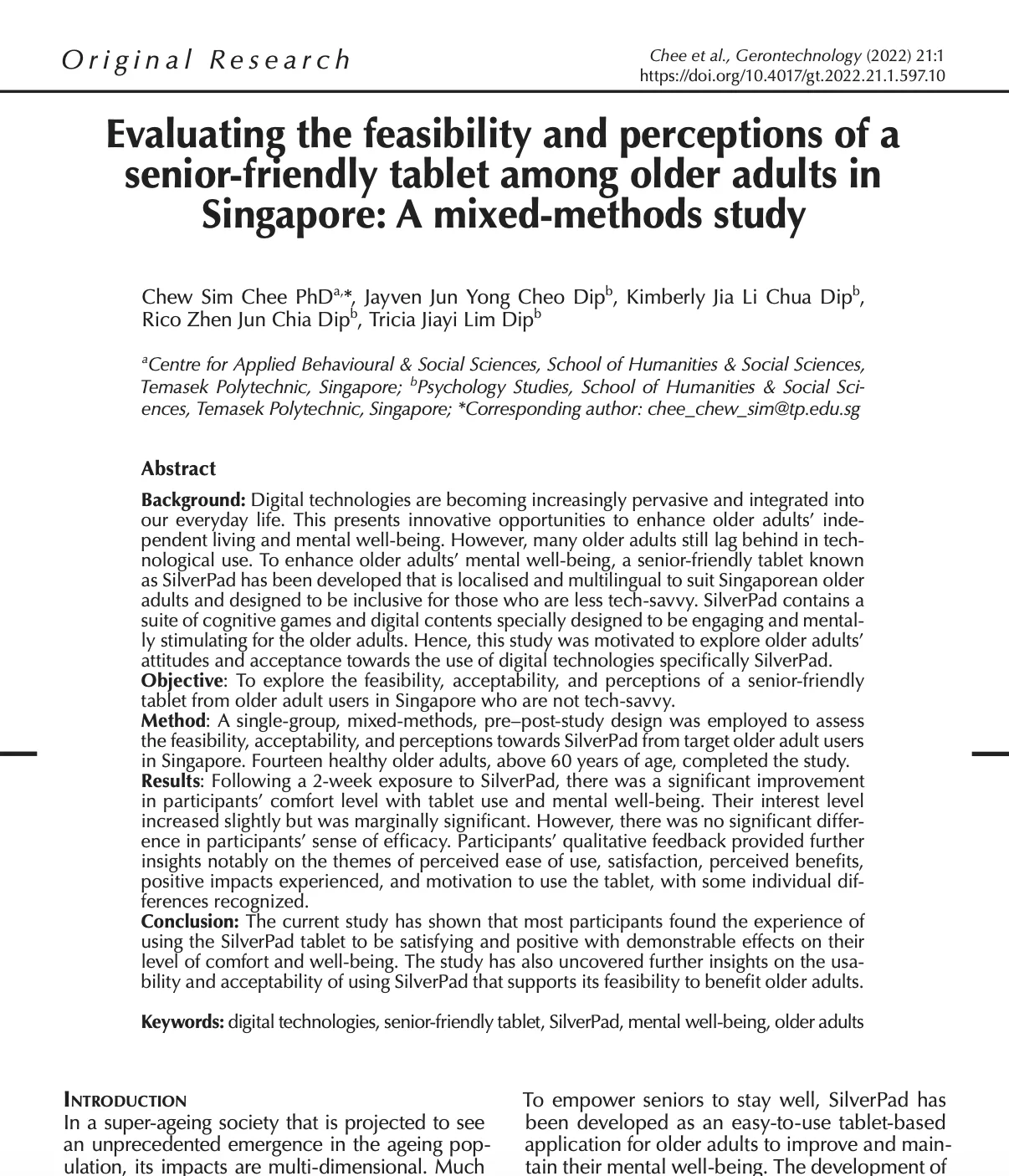
Read the full paper
The complete study, including the qualitative themes and the pre-post measures, is published open access in Gerontechnology.
Open the PDFFunded by SilverActivities. Approved by the Ethics Committee of Temasek Polytechnic, Singapore (study code SR5-EXT-2021).